BLOG
Your Accountability Partner Isn't Holding You Accountable
Nearly every man has an "accountability partner" — a mate he texts when he skips the gym, misses the deadline, or breaks the promise he made to himself. And nearly every one of those relationships follows the same script: he confesses, the other guy says "no worries, life happens," and nothing changes.
That's not accountability. That's a witness.
What Real Accountability Requires
Real accountability isn't comfortable, because it isn't about making you feel better about the excuse — it's about closing the gap between what you said you'd do and what you actually did. That means someone is allowed to ask "why didn't you?" and expects a real answer, not a shrug.
Face the Choice — the first move in the FORGED framework — means you can't hide behind "life happens" forever. Something happened. You made a choice in response to it. Real accountability asks you to name that choice out loud, to another man, and answer for it.
Why Men Avoid the Real Version
Fake accountability is easier beca...
Why Most Self-Improvement Content Is Making Men Weaker (Not Stronger)

Open your feed for five minutes and you'll get a dozen men telling you to "level up," "become the best version of yourself," or "unlock your potential." It feels good. For about an hour.
Then nothing changes.
That's not an accident. A huge amount of self-improvement content isn't built to make you stronger — it's built to make you feel something, because feeling something keeps you scrolling. Motivation is the product. You are the customer. And customers who feel good keep coming back for more of the same thing, without ever having to do the harder, less shareable work of actually changing.
THE MOTIVATION TRAP
Motivation is a mood. Moods pass. That's not a flaw — it's just what moods do.
The problem isn't that motivational content exists. The problem is when it becomes a substitute for discipline instead of a spark for it. You watch something that fires you up, you feel like you've done something — and by the time you're back at your desk or back in your kitchen, the feeling's gon...
Comfort Is the Addiction No One's Calling an Addiction
Comfort Is the Addiction No One's Calling an Addiction
Nobody sits a man down and tells him he has an addiction to comfort. There's no intervention for it, no support group, no app that flags it. But look honestly at a week of your life and it's there — the workout moved to tomorrow, the hard conversation avoided one more day, the goal you've mentioned for three years and never actually started.
That's not a motivation problem. Motivation was never going to carry you that far anyway. It's a comfort problem, and it's been managed so well by the world around you that you've stopped noticing it's happening.
Every app on your phone, every subscription, every "smart" convenience is built on the same premise: remove friction. Don't make him wait, don't make him choose, don't make him work for it. That's not an accident of good design — it's the business model. Comfort sells. Discomfort doesn't. So everything in your daily life is quietly incentivized to keep you soft, and to call it conve...
The Coasting Audit: Why Good Men Quietly Operate Below Their Own Standard
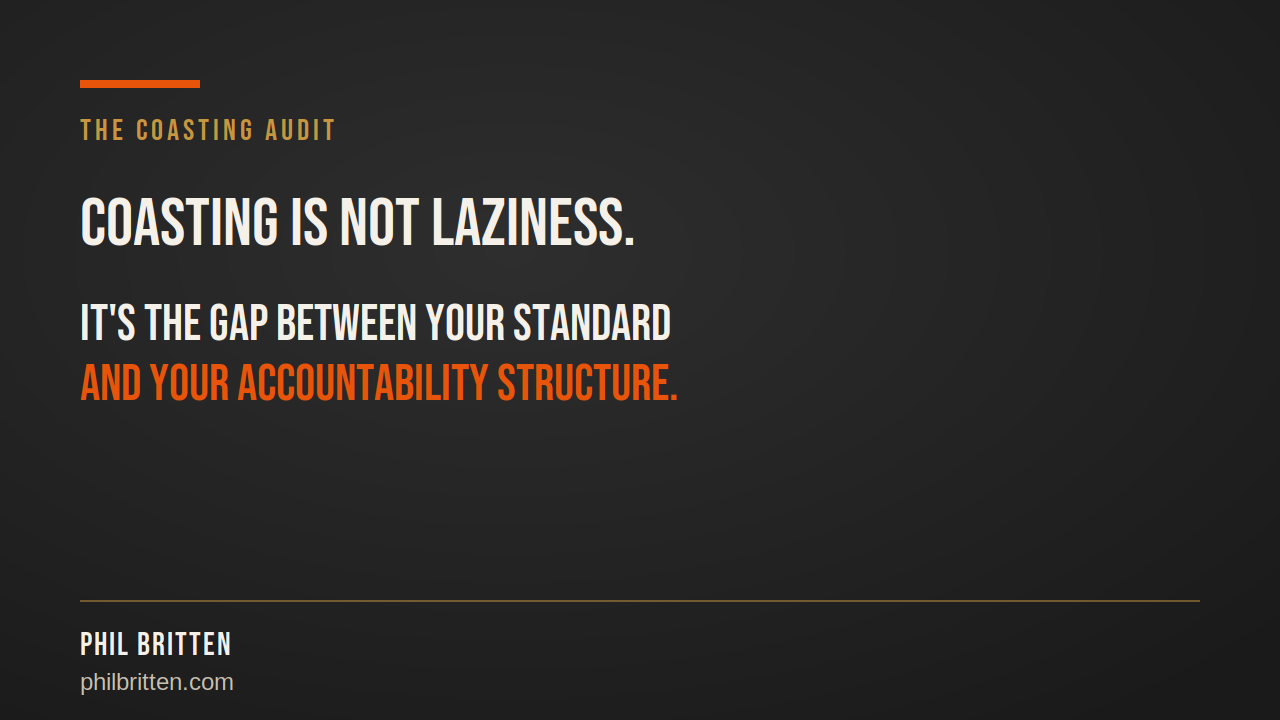
Coasting doesn't look like failure. That's what makes it dangerous.
A man who's coasting still gets up. Still shows up to work, still pays the bills, still shows up to the barbecue and laughs at the right moments. From the outside, nothing looks wrong. From the inside, he knows — he's not operating anywhere near what he's actually capable of. He's just not sure when that gap opened up, or how long it's been there.
I see this constantly in the men I work with. Successful by every external measure. Privately aware that somewhere in the last five, ten, fifteen years, they quietly stopped holding themselves to the standard they used to run by. Nobody made a decision to lower the bar. It just stopped being enforced — and standards without enforcement don't hold. They erode.
Coasting is not a character flaw. It's an accountability gap.
This is the distinction that changes everything about how you deal with it. If coasting were a character flaw, the fix would be self-criticism — try harder, b...